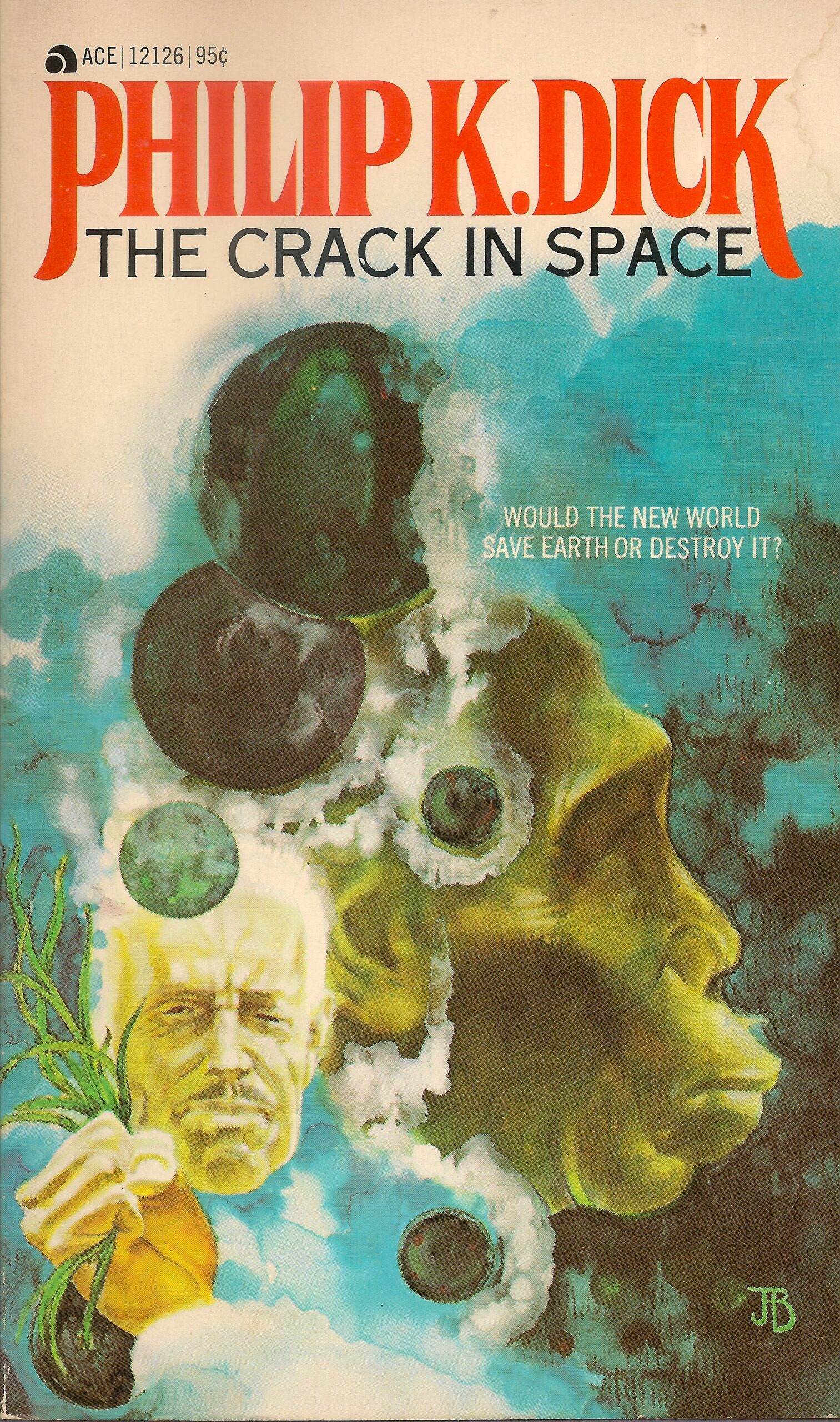
Just as the end of my 17th century of books found me reading a Philip K. Dick novel, as I make my meandering way through his books in quasi-chronological order of publication, so Book #1800 turns out to be—and yes, I obviously have some say in the matter—PKD’s 1966 science fiction novel The Crack In Space. This tale of a future world where finally the U.S.A. may be about to get a black president—this is set in 2079 or 2080 (is that right?), so it’s not entirely implausible—has the usual set of characters just trying to get on with their lives as car salesmen (well, people use Jiffi-scuttlers now, but don’t let that throw you), a presidential candidate and his advisers, a two-bodied one-headed owner of a pleasure satellite with five thousand (5000!!) girls all waiting for the next businessman to arrive, and a host of others. Meanwhile, a defective piece of equipment may enable the nation and world to divest itself of the growing hordes of people who’ve chosen to simply sleep their lives away, to be frozen in time in hopes that rampant overpopulation and lack of jobs and food and space will magically be resolved at some point in the future. Will those sleeping millions be able to use the titular ‘Crack in Space’ to blow this taco stand? Will careers be made? Will opportunities be squandered? Will we learn anything at all, this time?
Since it’s Philip K. Dick, the answers to all those questions, save perhaps the last one, may not become entirely clear. The Crack In Space was written in 1966 (though I read the 1974 edition pictured here), and issues of race relations are highlighted throughout. But the novel is crazy good with so many wild ideas that I can’t even keep up. Example? The throwaway reflections on abortion in the middle of the book where the anti- side is given perhaps its most persuasive case in the moral relief of the abortion consultant character … with neither topic nor character mentioned again. The ideas of “Mozart In Mirrorshades” are offered here in extremely moving and perhaps more believable form. And … and … seriously, the hits keep coming, and the basic story of men running for office and trying to sell cars (or squibbles, or whatever they are this time) uses cosmically unique occurences as mere background to their brooding hopes and fears and whatever that perpetual Dickian musing really is. And ’tis even a fable about counting chickens, and also race prejudice, and socio-economics of overpopulation, and … like I said, I could go on, but read the book instead.
I’ll be posting the full list of this last hundred books read shortly, likely in the merry month upcoming.
My pace of reading was faster this century than last, 1.06 days per book versus the previous 1.28 dy/bk. Page count showed an uptick, at just under 216 average pages per book, or about 204 pages per day. Additionally, there were 23 books read which I categorized as Comics, meaning that I don’t count them towards my grand ‘Books Read’ total, though I obviously keep track of them in some sort of database mania. Including those give a reading pace of 0.86 days per book (which is part of the reason I don’t use these in the ‘official’ count), and 186-3/4 avg. pages per book; those 32-pagers drop the average page count quite a bit.
As I’ve been reiterating in these occasional reports, the heavy reading pace is an effort to keep my ‘Books Read’ greater or at least equal to my ‘Books Acquired’. I have yet to see a noticeable decline in the overall trend line, but at least there seems to be a plateau. For instance, over the same period I read this last hundred books, I managed to buy or be gifted 89, giving me a net improvement in my read books of … 11 books. If we throw in all the comics-related stuff read or bought, we get 123 vs. 91, for a net of 32. Hmm, noticeable but still not even a dent to my shelves.

The first book of this last set of one hundred books saw me reading another PKD work, the next novel in chronological order in fact, though Book #1701 was the SF digest Fantastic from December 1964, which carried the first appearance of the novella “The Unteleported Man”, later published in 1966 as one half of an Ace Double book. The history of that novel or novella or what-have-you is an interesting bibliographic tale, as Dick greatly expanded the story but those pages were lost, then found, then found in a different format once again. At this point, there are three different versions of this novel, which—truth be told—may not be all that worthy of so much attention. (It’s a bit of a hodgepodge in the first two versions, which I have read. But!) But I’ve gotten a copy of a 2003 edition of Lies, Inc. (the expanded book’s new title), where new discoveries made in 1985 supposedly allow the publishers to stick the new material in the places that Philip K. Dick originally wanted them to be. So we shall see, as that’s my next PKD read, given that I recently read the 1966 version (same as the 1964 digest publication), and it’s also next on my fuzzy little list. Can’t wait to discover whether it holds up better than the first two renditions.
Mystery books regained their status as the plurality of books read in this set of 100, beating out Science Fiction & Fantasy which had been the dominant genre in the previous 2 tranches of one hundred books read. 32 books—almost a third!—of this last set were in the Mystery & Thriller category. But SF&F had 20 books to its credit, a quarter of which were Philip K. Dick novels. The 13 Children’s books were more than the 11 Fiction titles, with no other subject achieving double digits..
Those good at math have already calculated the 106 days to read these last 100 books, about 20% less than the length of time for the previous hundred. If we include the comics, the pace was a ludicrously fast 0.86 days per book read. Of course we don’t, so … moving on.
1 Book per 1..06 Days
See you soon with the complete Book List next month!
Leave a comment