
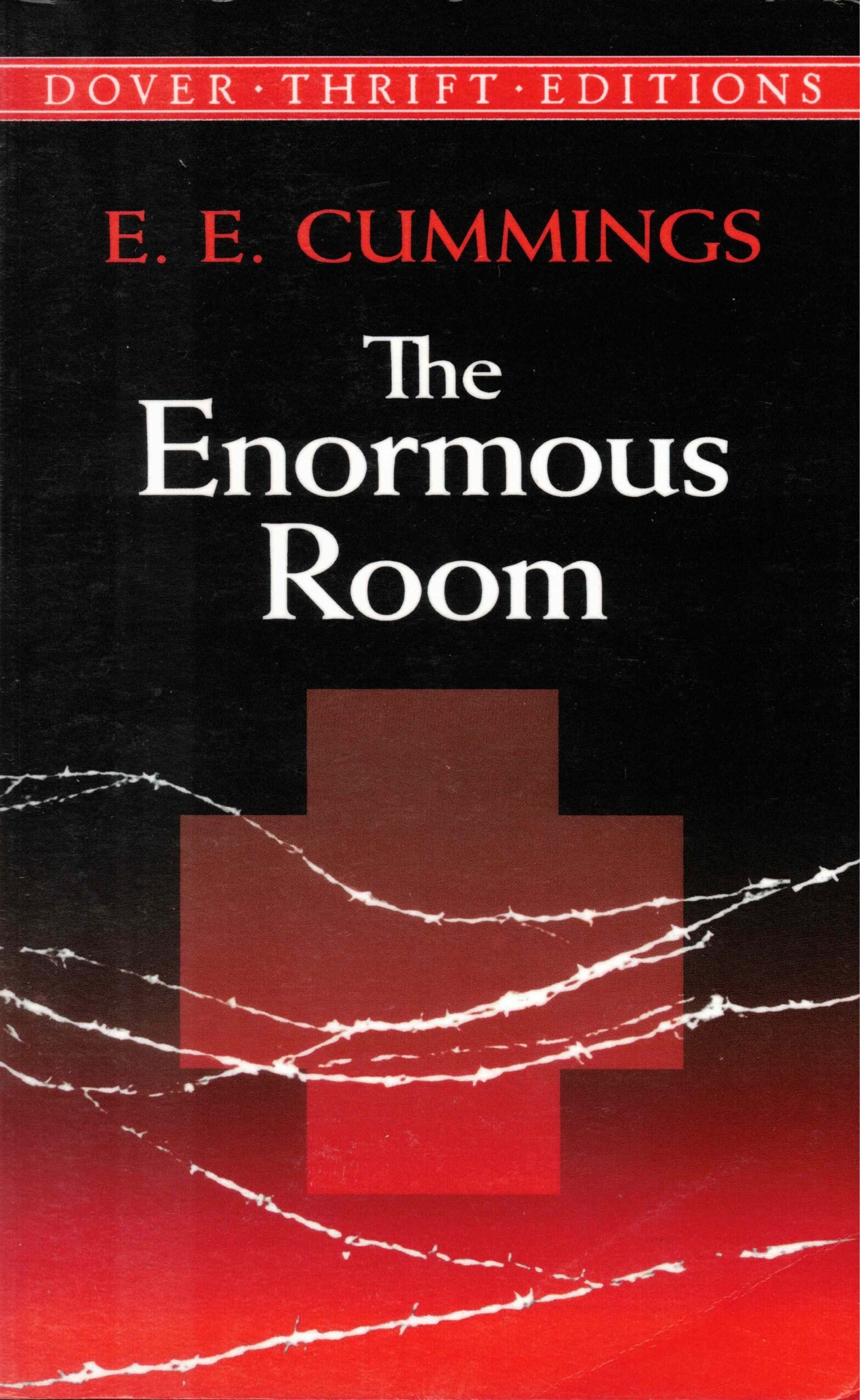
The Enormous Room, by E. E. Cummings
You will probably hate it. Or at least feel towards it that disdain nurtured by the forced reading of so-called ‘classics’ while you were enjoying or enduring the company of your fellow students during your teenage years. That seems to be the judgment of those reviews on Goodreads which bubble up to the top—at least in my feed. There are many who cannot stand the book, the prose, the high falutin’ stylistic nonsense, the upper-class airs of the narrator, the simpering patronizing of the sold black man in the entire novel (and there’s that word again). Some readers spoke of liking even loving his poetry, but found this autobiographical novel (Is it really that?) to be a bridge too far; some alluded to his politics in later life, his reactionary views. (It’s true. Look it up, if that’s what you need to judge an author’s work.) Of course, I knew none of this before reading The Enormous Room, so why am I bringing it up now?
Had I, at this moment and in the city of New York, the complete confidence of one-twentieth as many human beings I should not be so inclined to consider The Great American Public as the most æsthetically incapable organization ever created for the purpose of perpetuating defunct ideals and ideas.
In which our narrator shows off that high falutin’ stylistic nonsense
Because, by gum, I absolutely love love love this book. And I was surprised by the animosity, stunned at the misreadings evident on the Goodreads pages. Yes, I expected the prose might be difficult for some, and I know for a fact that my poor knowledge of French was at least sufficient—with a few instances of looking up this or that term (Who knew poêle meant stove as well as frying pan? Oh, right, everybody who actually speaks French)—to keep me engrossed in the tale told and not annoyingly distracted by the pretensions of this Harvard-educated upper-class child of privilege, playing at being a tourist among the proletariat who ended up getting his fingers burned because he didn’t know enough to keep his mouth shut when he should have kept his mouth shut.
The Enormous Room by E. E. Cummings tells the tale of the horrid and strange adventure that befell two white boys from New England who, whilst hieing off to volunteer duties with an ambulance corp during World War I, met each other aboard a ship and fell deeply in friendship. Perhaps this is the first off-putting idea in Cumming’s narrative, as the bond between the narrator (Cummings) and ‘B.’ (as he is called in the book) is so strong that when one is accused of anti-war sentiment the other insists on being jailed alongside his friend. Our ‘modern’ cynical not to say sneering simplistic suspicious age sees only the ‘love which dare not speak its name’ behind any deeply abiding relationship between two men, and the age also, in its secret blackened godless heart where it occasionally knows that something fundamental has been lost, somewhere, the age also labels any such relationship as ‘not truly love’, as lust or something even more base than that. And were the author and B. gay sexy time partners? (Whatever that might mean in 1917.) Who knows, and more importantly, what difference does it make? Can a person deeply admire and care for another without having to want to stick some thing into another thing? Ah, me.
Be that howsomever it may (or may not) be, the book is the story of two young men who volunteer to support the Allies in World War I by working for an ambulance service near the front lines in northeastern France. Both our American buddies speak French pretty darn well, and find themselves enjoying the company of their French compeers, the ‘poilus‘, rather than that of the other American, Mr. A, who leads their particular ambulance battalion, and who insists (impotently) that our narrator and B. stop fraternizing with the dirty poilus and act more like ‘real Americans’—i.e., shave more often and affect that holier-than-thou we’ve-come-to-save-you attitude that apparently Mr. A thought important. Of course, Mr. A can’t speak French, and has an unfortunately all too common disdain for the smelly Frenchmen he is forced to endure. Mr. A doesn’t like these bohemian college boy poseurs with their obvious contempt for the glories of American save-the-world culture, and so when the French authorities arrest B. on charges of treason—because B. has written anti-war statements in letters read by the French military censors—Mr. A does nothing to intervene, and, the narrator suspects, may have actively conspired in the kangaroo proceeding by which B. loses his liberty, hoping to get rid of a troublemaker or two. The ‘hearing’ on the charges then summons our narrator, who has only to disavow his friend to avoid facing the same imprisonment in durance vile; but Cummings refuses to betray his friend, indeed he insists on joining his fate to that of the obviously criminal B.
From this small acorn grows the beautiful narrative of what in another writer’s hands might have been a nightmarish Kafkaesque tale of what really is one of the vilest of durances. But, as B. tells our writer when he finally arrives in the concentration camp located far to the west of Paris, after an exhausting journey into mindless imprisonment, “Cummings, I tell you this is the finest place on earth!” And Cummings agrees. Agrees even though he and B. are confined to a large church-like room surrounded by stone walls and barbed wire, a room with filthy floors, six buckets to piss into (and around which a muddy morass of urine-soaked earth lingers), another to shit in, boarded up windows, and dozens of other potential ‘traitors’ awaiting their final judgment. For our two Americans have ended up in La Ferté Macé, a transit point for suspects awaiting a panel of ‘Three Wise Men’ who will decide whether or not they must be imprisoned “for the duration”. Simply put, their prison is a hellhole.
So why do these two strange Americans consider La Macé “the finest place on earth”?!? Because here once again we see the passion for life and living that made Cummings and B. fraternize with their fellow ambulance crewmen even though the latter were dirty Frenchmen. And perhaps both of these callow Americans are simply overjoyed to experience a world unknown to them, they with their upper-class protected upbringings and book learning of French (and Latin and Greek, at least in E. E. Cummings’s case). Everywhere he looks, our narrator is overwhelmed and overjoyed at the vibrant action and power and zest for life that goes on even here, in this strange Limbo of missed connections and inhumanity. To tell you of the strange characters he meets would be to deprive you of his wonderfully odd prose. Which you may hate. Sometimes Gertrude Stein grates on my nerves, too. But he is a wonderful reporter, and limns as strange a set of characters as ever did John Kennedy Toole or (another child of doubtful privilege) John Irving. Four of these personages he calls the “Delectable Mountains”, by which he means supremely vibrant men who are not defeated—though some are undone—by their time in this very minor branch office of Hell.
He is, of all the indescribables I have known, definitely the most completely or entirely indescribable. Then (quoth my reader) you will not attempt to describe him, I trust.—Alas, in the medium which I am now using a certain amount or at least quality of description is disgustingly necessary. Were I free with a canvas and some colors … but I am not free. And so I will buck the impossible to the best of my ability. Which, after all, is one way of wasting your time.
Cummings wastes some ambiguous person’s time
For hellish it certainly is. He writes of the events which lead up and into La Ferté Macé in fairly regular chronological order, if in an idiosyncratic style. But chronology and linear narrative are seemingly lost after he re-encounters B. and is initiated into the strange sordid confinement that will be his ‘home’ for the next few months. (Is it only months? Only those who have gone through unremitting oppressive daily unending torment can appreciate just how debilitating and mind-shattering such events can be, especially if, as in his case, there seems to be no defined terminus date post quem such ordeal will end.) Though the rest of the 20th Century—and what we’ve seen so far of the 21st—demonstrates that man’s inhumanity to himself seems to have no bottom, no depth beyond which he will not reach a further execrable horror, Cummings certainly experienced a trial which would bend and leave bereft most of us, especially we children of privilege who have not (yet) been subject to inconscient arbitrary injustice for what amounts to no reason at all. The horrors endured by the female prisoners, in particular, who are confined just adjacent to the men’s chamber, make Cummings pause and reflect and confess that the women are stronger, much stronger than he or any other man will ever be.
For besides the remarkable fellow prisoners he enjoys the company of, the polyglot set of supposedly treasonous ‘suspects’ dumped into this unholy melting ground of despair and disease (the man upon whom B. was based succumbed to scurvy), Cummings is most concerned to show his hatred of and scorn for ‘le gouvernement Français‘ and by extension all governments that would engender this and similar places, that would condone nay even create the creatures who build and populate these terrifying structures of stricture and nightmare. Thus he calls le Directeur of this instrument of mental oppression disguised as a transit prison camp by the name ‘Apollyon’, Greek for the Destroyer, the evil angel of the bottomless pit of hell. Just the sort of mindless adherence to meaningless rules and ideals that would allow Mr. A to consign his fellow Americans to prison for writing what many many believed (i.e., that the Great War was a useless waste of hundreds of thousands of lives for little or no purpose) is to Cummings’s mind as great a betrayal of humanity as is the active evil of the debased prison guards when they, for instance, try to silence a group of four female prisoners by filling the small ‘cabinet’ they are confined within with smoke from burning straw. The indomitable spirit of the four ‘putains‘ after they are nearly extinguished before the fire is doused inspires Cummings once more to both admire these unbreakable women and to despise the men and the social machine that gives them power over others.
it takes a good and great government perfectly to negate mercy.
Who will judge the judges?
There is much wonder in Cummings’s words as he portrays his fellow prisoners, the petty traitors (or suspected traitors; note as well ‘petty treason’ was the term old English law used for murder of a ‘social superior’) whose actual crimes seem to be being of German parentage, or overstaying a visa by a single day, or—in one instance—stealing three tins of sardines. For such crimes the mass of Dutchmen and Poles, Belgians and a Mexican, gypsies and Germans, all have been condemned to an indefinite sentence of servitude at the pleasure of the French government. But Cummings sees rather a group of men without the influence granted by money and position, the pimps with cash given more favors than those without the ready. But for a wonder, the petty and grinding and deadening sameness of each oppressive day do not break these men. Some do bend, and some are even folded or spindled or mutilated, or at least beaten—though the worst beatings are from fellow prisoners rather than from the guards, most of whom seem frightened to almost paralysis by the inmates in their keeping.
Among the battered and bent rejects is our author himself, or at least the narrator. Cummings shows this at two points, first at the scission between the chronological introductory part of his narration and the more impressionistic body of his work, where he points out that one’s existence in prison where each day is the same, where the hours of existence are reduced to exercise, food, exercise, food, roll call, sleep, where the numbing sameness of each day makes of each day a nonentity of timelessness, breaking the usual ideas of narration and ‘this then that and then this other thing’ that makes up most fiction. This decisive split in the structure of his ‘novel’ is parallel to the rupture at the heart of “For Esmé—with Love and Squalor” where Salinger’s sudden shift into 3rd person shows the ineffability of severely traumatic experiences—perhaps most unspeakable to the very persons who undergo such events.
The second breakdown of the narrative is shown during the increasingly fractured conclusion of the work, where Cummings admits that he quite lost himself when his compatriot B. was sent to ‘actual’ prison for his manifestly criminal treason of writing anti-war statements in personal letters. The episodic account gives way, our tale teller barely able to fix upon fact and incident, seeming to lose his grasp as the tale stumbles to its conclusion, a strange vision of a big city that has become forever changed.
Well, as I said, you probably won’t like it. Not only is it avant-garde in that way that only words created during the strange interregnum between the two ‘Great Wars’ of the 20th Century can be (viz. Dada, Stein), it is also arty itself, only words on paper from an artist who was not yet the poet sometimes known as e. e. cummings. The Harvard graduate thought he might perhaps become a painter, but so wanted to gain ‘real’ knowledge of the ‘real’ world he’d signed up to aid the wounded in the ambulance corps, just like another famous American writer. And, as I also said before, this prison stay is not of the worst type, not a taste of those camps that burned thousands of better men women and children than you or I shall ever be, nor yet the infamous gulags run by criminals that Solzhenitsyn described, now was it even the even earlier concentration camps of the English in South Africa where tens of thousands of Boers and blacks perished from disease, starvation, and neglect. No, the ‘Enormous Room’ wherein these dozens of unlucky men were confined was a small antechamber to the horrors of Hell, “not so bad” many might say who doubt not that they would be unchanged and unbroken by a few months sojourn in such a facility. Hell, at this very moment many putative non-Americans are suffering far more greatly in ICE ‘detention centers’, as we style our own more modern more efficient constructions of hell. And perhaps it is because La Ferté Macé was “not so bad” that Cummings was able to write about it at all. (I’m told that he never commented further on these experiences, told by those same shallow sources that gave me any number of reasons to discount his work, his views, his life. (Though you needn’t search Wikipedia for that; the chapter about “Jean Le Nègre” will provide you all the ammunition you need, so long as you ignore that a real man was being described, by another man who likely had had zero interaction with a black man who was not a porter.))
But this book is over a century old, the events it relates about a decade older than that, and …. Well, to quote a line I use often in daily conversation: Did we learn nothing from Vietnam? Or, to put it in the context of E. E. Cummings The Enormous Room: Did we learn nothing from World War One? Or, again, to reflect upon the America that I seem now to be imprisoned within with no hope of parole: Did we learn nothing from The Civil War? And the answer is the same, always the same in every case.
No. No, we did not. We learn nothing.