
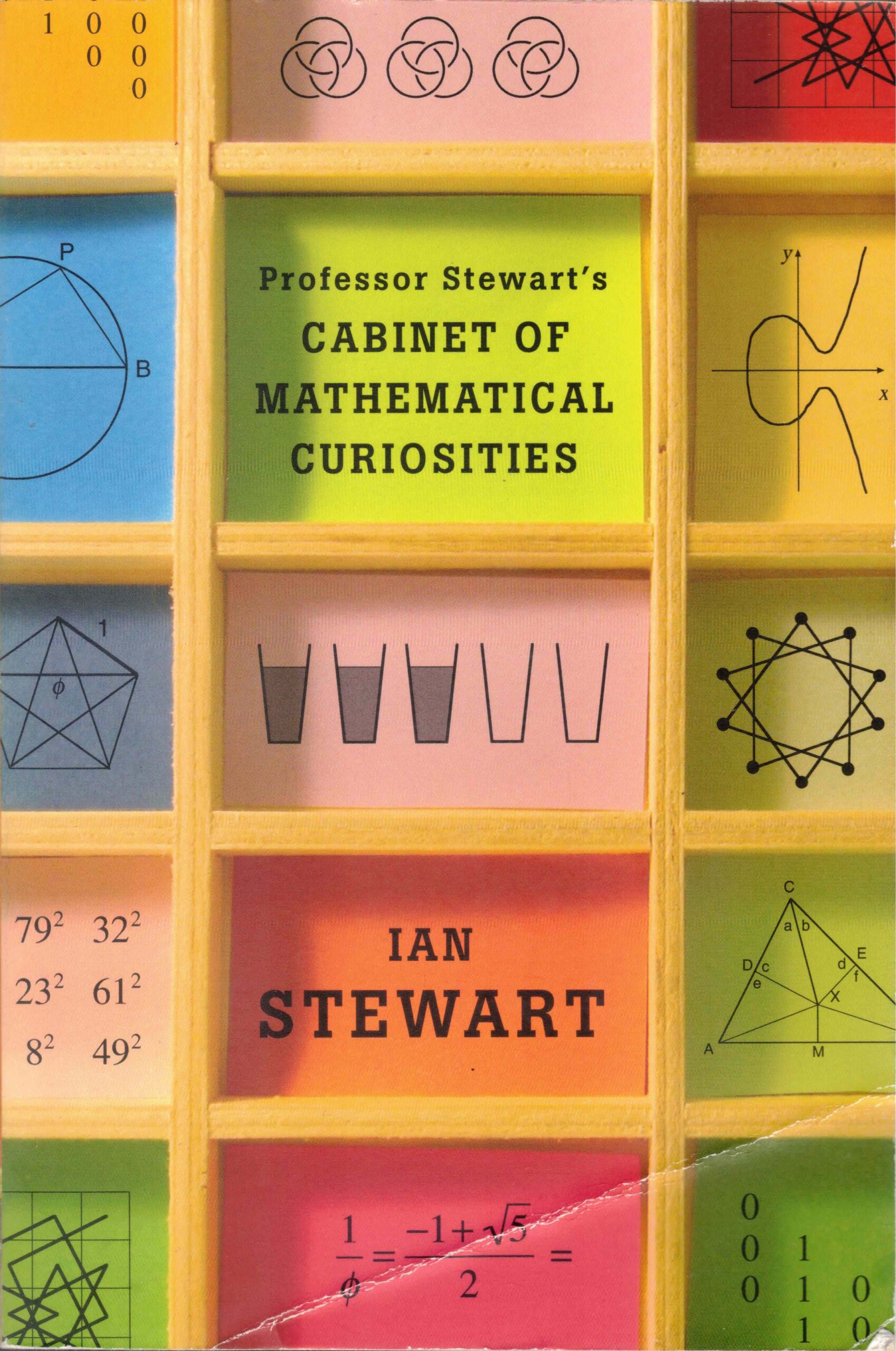
As promised, here is the complete listing of the last 100 books I’ve read. As is my standard practice, I do not count comics and graphic novels (or books of strips like Zippy or The Far Side, for that matter) towards that 100 book total, though I will list those here for your perusal and possible enjoyment. We started off the last century with the math populi book Professor Stewart’s Cabinet of Mathematical Curiosities, which was not the worst such book I’ve read, though I did find his explications a tad confusing, assuming facts not in evidence—which may have been aggravated by some noticeable typos in the text, as I mentioned before in that page linked to just above. So that’s Book #1601.

In the first 10 books of the last 100, the standout tome is quite obviously Stanley Lombardo’s translation of the Iliad. (As is usual in these periodic catalogs of my books read, I’ll be trying to highlight the best of the best, without descending into the joyful pit of hating on the bad trash I read … though sometimes the temptation becomes too great.) He may not be the most academically exact translator—his line numbers are not going to line up with the original Greek, for those of y’all playing the Home Game version of Homer—, but for sheer verve and readability nobody beats Lombardo. I am a huge fan of the Odyssey, had read it many many times before stumbling upon the Lombardo translation, but had never managed to get all the way through the Iliad before reading this version. Suddenly the ebb and sway of the decade-long battle and siege became clear, the passions of the Greeks and Trojans became real, and the doom upon almost all of these actors became a very real presence that could not be avoided, only met on the best terms possible. I really cannot recommend Lombardo’s Homer enough. (I still haven’t managed to get through the Aeneid in either his or another’s version, but that may just be me.)
| # | Read | Author | Title | Genre |
|---|---|---|---|---|
| 1601 | 9/3/25 | Ian Stewart | Professor Stewart’s Cabinet of Mathematical Curiosities | Mathematics |
| 1602 | 9/9/25 | Peter Matthiessen | Nine-Headed Dragon River | Religion & Spirituality |
| 9/9/25 | Sophie Crépon & Béatrice Veillon | L’Histoire de France en BD | Comics | |
| 1603 | 9/13/25 | “Richmond” | Richmond: Scenes in the Life of a Bow Street Runner | Mystery & Thrillers |
| 1604 | 9/13/25 | Philip K. Dick | Dr. Futurity | SF & Fantasy |
| 1605 | 9/16/25 | Jean de Brunhoff | Babar bientôt papa | Foreign Language |
| 1606 | 9/18/25 | O. G. Sutton | Mathematics in Action: Applications in Aerodynamics, Statistics, Weather Prediction and Other Sciences | Mathematics |
| 1607 | 9/19/25 | Emil Petaja | The Star Mill [Ace F-414] | SF & Fantasy |
| 1608 | 9/21/25 | Homer; Stanley Lombardo, trans. | Iliad | Poetry |
| 1609 | 9/22/25 | Norman Dodge | The Month at Goodspeed’s Book Shop February 1934, Vol. V No. 6 | Books |
| 1610 | 9/24/25 | Philip K. Dick | Vulcan’s Hammer | SF & Fantasy |

My first experience with this Brazilian wonder, the short stories of Clarice Lispector fascinated me and grabbed my head and my heart and my psyche and … well, it’s pointless to write about her writing. She writes too well to be lessened by my own cheap words of effusive praise. I will say, however, that I was enthralled to see the development of a woman’s spirit and voice from the inside, in a way that I’ve not read before. (Admittedly I’m a poor reader of women authors, both in quantity and in my conclusions. I am likely a hateful, horrible man.) The quality changes drastically towards the end of the works presented here in The Complete Stories of Clarice Lispector, but that may be as much my own failing as anything else. She is truly a rare genius, and—to the extent I can tell (I cannot tell)—these translations seem very good, or at least very persuasive. I am told I might not like her novels, but after reading these works, I must make the essay.

From my “Other” section of shelves comes this unclassifiable work of imaginary natural history originally published in German and translated in 1967 by Leigh Chadwick. The Snouters: Form and Life of the Rhinogrades is presented as written by the noted scientist Harald Stümpke, but of course is the work of Gerolf Steiner, who amused himself and myself with this delightful account of these lifeforms which evolved (and devolved) in every which way possible for mammals to go. The illustrations evoke the best of beauty in scientific drawing, and the crazy lengths to which Stümpke, I mean Steiner, goes to make this tract are well worth the effort to look up many many new words (to me), who passed biology by before I even got to high school. I learned more than I would ever expect to from a text that seems a prototype for the Journal of Irreproducible Results, and, due to the tragedy mentioned in the closing pages, the study of the Rhinogradentia—so named because their eponymous noses become used for every possible use a lifeform could find—is more irreproducible than most.
| # | Read | Author | Title | Genre |
|---|---|---|---|---|
| 1611 | 9/25/25 | Michael Bonner, ed. | Uncut Magazine December 2024 | Music |
| 1612 | 9/25/25 | Clarice Lispector; Katrina Dodson, trans. | The Complete Stories | Literature & Fiction |
| 1613 | 9/26/25 | Robert Benchley | Benchley Lost and Found | Humor |
| 1614 | 9/28/25 | William L. Hamling, ed. | Imaginative Tales Vol. 2 No. 2 November 1955 | SF & Fantasy |
| 1615 | 9/28/25 | Caroline Graham | The Killings at Badger’s Drift | Mystery & Thriller |
| 1616 | 10/1/25 | Wilkie Collins | Little Novels | Literature & Fiction |
| 1617 | 10/3/25 | John Reed | Ten Days That Shook the World | History |
| 1618 | 10/4/25 | Harald Stümpke (Gerolf Steiner); Leigh Chadwick, trans. | The Snouters: Form and Life of the Rhinogrades | Other | 1619 | 10/8/25 | Maurice Leblanc | Arsène Lupin, Gentleman Cambrioleur | Foreign Language |
| 1620 | 10/9/25 | Barry Hoffman, ed. | Gauntlet: Exploring the Limits of Free Expression Number 9 1995 | Politics & Social Sciences |

I only bought this digest because I could not believe that Ben Bova had actually said the words quoted in a book on deviance I’d read (Deviance and Moral Boundaries: Witchcraft, the Occult, Science Fiction, Deviant Sciences and Scientists by Nachman Ben-Yehuda for those of you playing along at home.). But he did, in an absolutely bonkers editorial arguing, stridently declaiming in fact, that Star Wars and Close Encounters Of The Third Kind are in no way no how anything at all to do with ‘real’ science fiction. I found myself liking the stories in this magazine much more than I expected, however. Perhaps that is merely nostalgia, as I was a subscriber to Analog around the time this June 1978 issue came out, and rereading the SF current at the moment when I was developing a love for the genre may have colored my thoughts about this ‘literature’ now. I always do love me a Randall Garrett parody, however. (The full Bova quote, in case you’re still wondering after wading through my blather, is as follows:
So, although “Star Wars” and “Close Encounters” are delighting millions and making their backers rich, neither film can be regarded seriously as science fiction. In fact, they bear the same relationship to science fiction as the Nazi treatment of Poland bore to the Tend Commandments.
)

Of course, my favorite book from this decade of books was the best Philip K. Dick novel, The Man In The High Castle. (I should point out, however, that I have four books which I will assert are the best Philip K. Dick novel.) I’ve been re-reading all the PKD novels in publication order, sort of, and so I came to 1962 and this his breakthrough work. The story of altered reality where the Axis won World War II still hits hard, and is made much more persuasive by just that restraint and focus on the minor day-to-day life of ordinary people in San Francisco just trying to get along under the Japanese occupation. Dick’s extensive research in the Nazi archives found in Berkeley really shows (and he’ll continue to mine that lode for the next half decade), but during this 2025 re-read I couldn’t help but notice his elision of such Japanese atrocities as Nanking or their own mad and murderous scientist wing, Unit 731; whether this was a conscious choice or simply not part of his research, I couldn’t say. Still, this is a brilliant book, and Dick plays to his strengths, building a story of believable humans in his mosaic of another world which is, of course, this world.
| # | Read | Author | Title | Genre |
|---|---|---|---|---|
| 1621 | 10/10/25 | Henry Kane | Peter Gunn | Mystery & Thriller |
| 1622 | 10/15/25 | Becky Chambers | The Long Way to a Small, Angry Planet | SF & Fantasy |
| 1623 | 10/17/25 | Michael Bonner, ed. | Uncut Magazine Review of the Year 2024 | Music |
| 1624 | 10/20/25 | Ben Bova, ed. | Analog Science Fiction/Science Fact June 1978 | SF & Fantasy |
| 10/21/25 | Mike Baron | Badger #40 | Comics | |
| 1625 | 10/24/25 | Wilkie Collins | Hide and Seek | Literature & Fiction |
| 1626 | 10/26/25 | H. L. Gold, ed. | Galaxy Science Fiction October 1952 | SF & Fantasy |
| 1627 | 10/26/25 | Michael Elder | The Alien Earth | SF & Fantasy |
| 1628 | 10/28/25 | Norman Dodge | The Month at Goodspeed’s Book Shop April 1934, Vol. V. No. 8 | Books |
| 1629 | 10/28/25 | H. L. Gold, ed. | IF Science Fiction September 1959 | SF & Fantasy |
| 31* | 10/29/25 | Philip K. Dick | The Man in the High Castle | SF & Fantasy |
| 10/30/25 | (Philip K. Dick) | Blade Runner (The Official Comics Illustrated Version) | Comics | |
| 1630 | 10/31/25 | Philip K. Dick | The Game Players of Titan | SF & Fantasy |
* I re-read this particular version of the PKD novel because I forgot that I’d already read and entered it in my database. (The last time was way back in January of 2016.) A shame, ’cause I have some other editions I could have read instead…

Should I feature another Philip K. Dick novel? Right after touting the High Castle? Of course I should! The Penultimate Truth comes from 1964, and tells the story of the mechanized warfare of the far future in the hellscape that the Earth’s surface has become, full of radioactivity and battling robots who have killed off every lifeform on the surface. On the rare chance that you don’t know the twist here, I’ll say no more. In this Bluejay Books edition, Thomas Disch provides a somewhat negative afterword which, I found, palliated to some extent this excellent novel. To my mind, PKD played to his strengths in ignoring most of Dicsh’s pearl-clutching concerns, and does what he does best: showing us the reality beneath, above, and beyond the surface. If he cannot show the reality of the plots of the high & mighty, who among us can comprehend their inhuman and callous machinations and their insensate world-unmaking?

The nostalgia mentioned in the 2nd set of ten books continues apace with my next read, and certainly the appearance of so much science fiction in my spotlighted books is unusual, compared to previous centuries of my reading. This one, Tactics Of Mistake, is definitely a blast from my own past as a teenaged reader. Part of Gordon R. Dickson’s fabled Dorsai series, these vignettes show the nascent military leader who will found the ‘pumped up’ SF mercenaries which became one of the early progenitors of today’s military science fiction. The battles of the brash young Cletus Grahame—really more set pieces designed to show off the bold new tactics of the hyper-trained (and a little lonely … ah!) tactician—are a fun read, were even more fun for a young teen with ideas of the glory of battle and like that. Of course, the premise is ridiculous, and it has always been easy to win battles when you write the script, but still and all this book exceeded my aged expectations of my youthful favorites, which do not always hold up on second or later meeting.
| # | Read | Author | Title | Genre |
|---|---|---|---|---|
| 1631 | 10/31/25 | Robert Howard | Swords Of Shahrazar | SF & Fantasy |
| 1632 | 11/1/25 | Norman Dodge | The Month at Goodspeed’s Book Shop May 1934, Vol. V. No. 9 | Books |
| 1633 | 11/1/25 | H. L. Gold, ed. | Galaxy Science Fiction Vol. 5 No. 2 November 1952 | SF & Fantasy |
| 1634 | 11/2/25 | Norman Dodge | The Month at Goodspeed’s Book Shop June 1934, Vol. V. No. 10 | Books |
| 1635 | 11/4/25 | Philip K. Dick | The Penultimate Truth | SF & Fantasy |
| 1636 | 11/8/25 | Gordon R. Dickson | Tactics of Mistake | SF & Fantasy |
| 1637 | 11/11/25 | Ellis Peters | The Devil’s Novice | Mystery & Thrillers |
| 11/12/25 | Bill Griffith | From A to Zippy: Getting There is All the Fun | Comics | |
| 11/13/25 | Goscinny & Uderzo | Astérix et le chaudron | Comics | |
| 1638 | 11/13/25 | Francis A. Soper, ed. | If You Smoke, What Have You? – Selections From Smoke Signals | Drugs |
| 1639 | 11/14/25 | Jonas Ward | Buchanan Calls The Shots | Western |
| 1640 | 11/14/25 | Michael Bonner, ed. | Uncut Magazine January 2025 | Music |
From famine to feast we go in this next set of ten books. I was complaining that there weren’t many choices to highlight through the first 40 books in my last set of 100 read, and now in the last tranche of ten before the midpoint I have a plethora of outstanding books, stellar works I’d put front and center if only I had world enough and time. Most of the kids’ books fall into this category, with the Virginia Lee Burton being wistful nostalgia for a time long past and now even longer paster. Ah, me! The Thornton Burgess is, of course, a little preachy, but the tales have a real heart beneath their silly moralizing, and they are also interesting and fun. But I’m determined to give you only two from these ten, so here they are:

Staggeringly good. Early English: A Study of Old and Middle English by John W. Clark is one of those rarest of beasts: a well-written overview of a difficult subject that leaves the reader both better informed and equipped to learn more. Clark also manages to make the descent from Old to Middle English much clearer than I’ve ever grokked before, with all the historical and other factors laid out for our inspection—those which we can be sure of, in any event. This is a tight précis by one who obviously knows his subject backwards and forwards and yet chooses to explain it in a straightforward but not condescending manner. I found some difficulty with both the pronunciation guide and the applied sections under OE and ME, but I have a hard time with IPA generally. Highly recommended.

I said some harsh words about the afterword Disch wrote for that PKD novel above, but I cannot stay mad, not after reading this stunning antiwar novel which manages to subvert about three genres at once, all while playing on strange Dr. Moreau meets Flowers For Algernon vibes. Camp Concentration by Thomas Disch is deservedly acclaimed, science fiction that pulls you in before you’re reading about the future or now or you don’t even know anymore. And though I patted myself on recognizing the first ‘reveal’ of the book long before the narrator, I wasn’t prepared for … well, best if you discover that for yourself. Wow. This is an amazing and revelatory book, though I wonder sometimes about its harsh verdict upon ‘genius’; Harrison Bergeron would like a word.
| # | Read | Author | Title | Genre |
|---|---|---|---|---|
| 1641 | 11/15/25 | Frederik Pohl, ed. | IF Science Fiction Vol. 13 No. 6 January 1964 | SF & Fantasy |
| 1642 | 11/16/25 | John W. Clark | Early English: A Study of Old and Middle English | Language & Linguistics |
| 1643 | 11/17/25 | Thornton W. Burgess | Mother West Wind “Why” Stories | Children’s |
| 1644 | 11/17/25 | Virginia Lee Burton | The Little House | Children’s |
| 1645 | 11/17/25 | Virginia Lee Burton | Mike Mulligan and His Steam Shovel | Children’s |
| 1646 | 11/17/25 | Jean de Brunhoff / Florence Hayes | The Story of Babar / Johanna Spyri’s Heidi | Children’s |
| 1647 | 11/18/25 | Jean de Brunhoff / Beatrix Potter | The Travels of Babar / The Tale of Peter Rabbit | Children’s |
| 1648 | 11/18/25 | Jean de Brunhoff / Beatrix Potter | Babar and Zephir / The Tale of Squirrel Nutkin | Children’s |
| 1649 | 11/18/25 | Jean de Brunhoff / Beatrix Potter | Babar and His Children / The Tale of Benjamin Bunny | Children’s |
| 1650 | 11/19/25 | Thomas M. Disch | Camp Concentration | SF & Fantasy |

I was reading a lot of children’s books during this stretch, trying to pump up my numbers like a CFO just before earnings. And this set of ten books was much less great than the ten that preceded it. (Captain Underpants didn’t seem to hold up very well, heh-heh. I guess the elastic had gotten old and all stretched out.) But there were some real winners, though likely you’ve read them time and time again heretofore. One which was new to me was Marguerite Henry’s Misty of Chincoteague, one of the classics about horses which it seems that women of a certain age simply had to read as young girls, just as young boys had to decide whether they were DC or Marvel. But I’d never read it before, and was so happy I got the chance now. I finished reading it with happy tears simply streaming down my face. It’s a blessedly beautiful story, wish fulfillment at its finest, and suddenly I wanted to be a ‘horse boy’.

I do not feel compelled to re-read Winnie-the-Pooh in the same way I insist to myself that I’m gonna read some version of Alice In Wonderland (or Through The Looking Glass, or both) every hundred books or so. (Checking my data shows that I’m on a Lewis Carroll pace of closer to once every 200 books.) But every time I read the two classic books by A. A. Milne about the not-very-bright stuffed bear, I forget my lifelong animus towards stuffed Teddy Bears and feel heartened by just life the way it is. Winnie-the-Pooh is still just one of the most remarkable children’s books of all time. Every page has phrase and constructions to delight, the Shepard illustrations are a wonder, and there is a surfeit (only you can’t ever have too much, you know) of compassion and clear thinking.
| # | Read | Author | Title | Genre |
|---|---|---|---|---|
| 1651 | 11/19/25 | Dav Pilkey | Ricky Ricotta’s Mighty Robot Vs. the Mutant Mosquitoes from Mercury | Children’s |
| 1652 | 11/20/25 | George Sims | The End of the Web | Mystery & Thriller |
| 1653 | 11/20/25 | Dav Pilkey | The Adventures of Captain Underpants | Children’s |
| 1654 | 11/20/25 | Dav Pilkey | Captain Underpants and the Attack of the Talking Toilets | Children’s |
| 1655 | 11/21/25 | Dav Pilkey | Captain Underpants and the Invasion of the Incredibly Naughty Cafeteria Ladies from Outer Space (and the Subsequent Assault of the Equally Evil Lunchroom Zombie Nerds) | Children’s |
| 1656 | 11/21/25 | Marguerite Henry | Misty of Chincoteague | Children’s |
| 1657 | 11/22/25 | Samuel R. Delany / Keith Woodcott | Captives Of The Flame / The Psionic Menace [Ace Double F-199] | SF & Fantasy |
| 1658 | 11/22/25 | Dav Pilkey | Captain Underpants and the Perilous Plot of Professor Poopypants | Children’s |
| 1659 | 11/23/25 | A. A Milne | Winnie-the-Pooh | Children’s |
| 1660 | 11/23/25 | Dav Pilkey | Captain Underpants And The Wrath Of The Wicked Wedgie Women | Children’s |

The next book decade continued the focus on children’s books, for the same unworthy reason of pumping up the numbers. But there were still treasures to be found; I’d never read any of the Frog and Toad books before, only knowing them through memes. (What a world.) And if you don’t know the art of Joel Nakamura, his little book of devils going to sleep, Siesta, is a fine introduction. I like as well his robots and Godzilla paintings, but his devils and other nasties are always an awesome delight.

I have not highlighted Beatrix Potter since my listing of Books #401–#500, so it’s worthwhile mentioning once more how gratifying spending time with her stories and illustrations can be. This time I killed two (very small) birds with one (quite precious) stone, both getting my total books read count up and also working on my comprehension of the French language—which is abysmal. A children’s book of less than 60 pages with hardly two sentences to every other page is just about my speed. But Potter’s illustrations are still wistfully wonderful, and L’Histoire de Toto le Minet (Tom Kitten for y’all Potter purists) is a very compelling story of troublesome kittens … but then again, what did their mother expect?
| # | Read | Author | Title | Genre |
|---|---|---|---|---|
| 1661 | 11/23/25 | Dav Pilkey | The Captain Underpants Extra-Crunchy Book o’ Fun | Children’s |
| 1662 | 11/24/25 | Dav Pilkey | The All New Captain Underpants Extra-Crunchy Book o’ Fun 2 | Children’s |
| 1663 | 11/24/25 | Joel Nakamura | Siesta | Children’s |
| 1664 | 11/24/25 | Barbara Brenner | Walt Disney’s Three Little Pigs | Children’s |
| 1665 | 11/24/25 | Arnold Lobel | The Frog and Toad Treasury [Frog and Toad Are Friends / Frog and Toad Together / Frog and Toad All Year] | Children’s |
| 1666 | 11/24/25 | V.M. Hillyer | A Child’s History of the World | Children’s |
| 1667 | 11/25/25 | H. L. Gold, ed. | Galaxy Science Fiction Vol. 5 No. 3 December 1952 | SF & Fantasy |
| 1668 | 11/26/25 | Beatrix Potter | L’Histoire de Toto le Minet | Foreign Language |
| 1669 | 11/26/25 | Andrew Quiller [Kenneth Bulmer] | The Gladiator: The Land of Mist | Fiction |
| 1670 | 11/27/25 | William P. Gottlieb | The Golden Age of Jazz | Music |

In addition to reading the kids’ books to pump up my numbers, I read any number of comics for the same purpose in the last set of 100 books. Now, it is true that I don’t count comics towards the ‘official’ 100 Book Count; but I do keep track of the total books read—of all types—versus the total number of books bought or otherwise acquired. (TBH, I just read a half dozen Amar Chitra Katha comics in my collection for just this reason, primarily motivated by the fact that I just bought over 25 books at a local estate sale. The problem continues.) And thus it was that I read between Books #1571 and #1572 two numbers of Rip Off Comix. And boy howdy was issue #1 a great ball-o’-fire! The Fabulous Furry Freak Brothers and of course Wonder Wart-Hog stories were standouts, of course, but I also just loved loved loved (as I almost always do) the Griffith Observatory pieces, from the creator of our favorite pinhead. Issue #7 hadn’t quite the same charm on every page, and I prefer Dopin’ Dan to Dealer McDope, but the Dick Whittington Fat Freddy’s Cat tale was a surefire winner. Good stuff!

Having been burned by Martin, I approached Kingsley Amis’s mystery tale with some trepidation. I’d only read his poetry heretofore—which is quite good—but found myself absolutely entranced by The Riverside Villa Murders. The novel is a startlingly good recreation of a ‘30s British mystery, with weirdly ‘pansified’ elements which turn out to be absolutely necessary to the story. The denouement was mostly satisfactory (a rarity in mysteries written by litterateurs), and though I knew who I hadn’t worked out how, and in this case that’s not the point, and the words between father and son at the close are some of the best stuff of the sort since perhaps Atticus Finch.
| # | Read | Author | Title | Genre |
|---|---|---|---|---|
| 1671 | 11/27/25 | Robert Aitken | Zen Master Raven: Sayings and Doings of a Wise Bird | Religion & Spirituality |
| 11/27/25 | Gilbert Shelton, Frank Stack, Ted Richards, Dave Sheridan, Bill Griffith, & Justin Green | Rip Off Comix #1 | Comics | |
| 11/27/25 | R. Diggs, Dave Sheridan, Joel Beck, Bill Griffith, Gilbert Shelton, & Frank Stack | Rip Off Comix #7 | Comics | |
| 1672 | 11/28/25 | Kingsley Amis | The Riverside Villas Murder | Mystery & Thrillers |
| 1673 | 11/28/25 | H. L. Gold, ed. | Galaxy Science Fiction Vol. 5 No. 4 January 1953 | SF & Fantasy |
| 1674 | 11/30/25 | Charlotte MacLeod | The Odd Job | Mystery & Thrillers |
| 1675 | 11/30/25 | D. M. Black, Peter Redgrove, & D. M. Thomas | Penguin Modern Poets 11: Black Redgrove Thomas | Poetry |
| 1676 | 11/30/25 | Michael Bonner, ed. | Uncut Magazine February 2025 | Music |
| 11/30/25 | Jim Vadeboncoeur, Jr., ed. | Seduction of the Innocent #3 | Comics | |
| 11/30/25 | Jim Vadeboncoeur, Jr., ed. | Seduction of the Innocent #2 | Comics | |
| 11/30/25 | Jim Vadeboncoeur, Jr., ed. | Seduction of the Innocent #1 | Comics | |
| 1677 | 12/1/25 | William R. Hunt | Dictionary of Rogues | True Crime |
| 1678 | 12/2/25 | Woody Allen | Without Feathers | Humor |
| 1679 | 12/4/25 | Jack London | Stories of Hawaii | Fiction |
| 1680 | 12/4/25 | Peter Alding | Ransom Town | Mystery & Thrillers |

Another slice of ten books in which a plethora of great books makes choosing just two to focus on a very difficult choice. I mean, can I really pass up Martian Time-Slip? How can I skip over that absolute banger by Philip K. Dick about madness and isolation and society and its downsides? But I can, because I must instead highlight a couple of perhaps lesser known (at least to me) works which I think very worthy of mention. And first up is Eric Brighteyes, a novelization recreation of a Norse (or Icelandic) saga which truly lives up to its ideal. That the author is H. Rider Haggard does not hurt at all, and he shows here that he can write action in a completely different style than his classic King Solomon’s Mines. The book perhaps dragged a bit in the middle, but then, so do some sagas. But the inevitable ending is stellar, as is the entire working out of one of the grandest conceits I’ve come across in literature. Of course, Haggard’s tale cannot compare to Njal’s Saga—but that’s one of the Top Ten greatest works of all time. But his ability to translate the millennium-old tales of Iceland into a modern (late 19th C.) novel is stunning, as is his realization of this reality-based fantasy. Top marks!

Not sure what I expected (likely just another throwaway mystery read to occupy some time; value received for the $1 spent at the local library book sale), and I confess I started this one two or three times before finally getting into it, but I discovered a powerful book reminding me of The Long Firm by Arnott. Without giving anything away, I found its unfolding of the mystery as interesting as the unraveling itself. Death In The Garden by Elizabeth Ironside (pen name for Catherine Manning) is staggering in its brilliance, both for its recreation of another ancien regime now gone as well as for the depiction of multiple characters through a very wide variety of lenses. Perhaps you’ll guess the mystery, and the other one, as I did, but still … Ironside’s novel becomes, in the end, another type of book altogether, a pensive reflection on the nature of time and choice and human life and the passions and suppressions that are lived with—or not.
| # | Read | Author | Title | Genre |
|---|---|---|---|---|
| 1681 | 12/6/25 | H. Rider Haggard | Eric Brighteyes | SF & Fantasy |
| 1682 | 12/8/25 | H. L. Gold, ed. | Galaxy Science Fiction Vol. 5 No. 5 February 1953 | SF & Fantasy |
| 1683 | 12/10/25 | Philip K. Dick | Martian Time-Slip | SF & Fantasy |
| 1684 | 12/11/25 | Sarah Caudwell | The Shortest Way to Hades | Mystery & Thrillers |
| 1685 | 12/11/25 | Leslie Charteris | Señor Saint | Mystery & Thrillers |
| 1686 | 12/13/25 | L. Frank Baum | The Magical Monarch of Mo | Children’s |
| 1687 | 12/13/25 | Elizabeth Ironside | Death in the Garden | Mystery & Thrillers |
| 1688 | 12/20/25 | P. G. Wodehouse | The Luck of the Bodkins | Fiction |
| 1689 | 12/22/25 | Louis Trimble | The Wandering Variables | SF & Fantasy |
| 1690 | 12/27/25 | Leslie Charteris | The Saint in New York | Mystery & Thrillers |

Finally got a chance to read Lookout Cartridge by Joseph McElroy and … hrm, afraid I may have to damn this one with faint praise. On the one hand, the amazingly sustained stream-of-consciousness writing is pretty much a tour de force, truly masterful, especially in its revelation of the novel’s plot in the haphazard ping-ponging way that actual thought takes. On the other hand … the sustained voice is a strangely distant one, which ended up making me very very sleepy, as if hypnotized rather than transfixed by the action, and the difficulties of accessing the plot seemed a bit trop, and the dénouement a bit forced—if such can be said about a revelation that spans pretty much the last hundred pages, or ~20% of the book. It’s easy to see why comparisons are made between McElroy and Pynchon (and Gaddis, but I still haven’t caught up with that author yet), but the hooks here—Tell you what: Let’s just assume I’m a poor reader and missed overwhelmingly the entire point of the novel. YMMV

I’ve already told you about The Simulacra in my preliminary announcement of 1700 books read, so instead here I’ll talk about A Case Of Need, an early work by Michael Crichton, who published this his 3rd novel in 1968 under the pen name Jeffery Hudson. Perhaps to tout Crichton after my side eye at McElroy shows my pedestrian tastes (it does), but I also think there’s a place for writing parallel to that art brought to the fore in Baudelaire’s The Painter of Ordinary Life. The ability to write page-turning fiction that doesn’t make you feel guilty after you finish is a rare one which should be celebrated. This Crichton novel kept me turning the pages and guessing—though admittedly as soon as he left the hospital the plausibility dropped drastically. The out-of-date elements (abortion crime, no informed consent, etc.) make this one more interesting, not less—although I am told this one hits very different for a woman reader. This taut, well-planned thriller uses a trope that is always a favorite of mine: the non-detective detective. Crichton does well here what he does best, in a complex drama of strong personalities and stronger emotions (no sex scenes, which is for the best, as that’s what Crichton does worst).
| # | Read | Author | Title | Genre |
|---|---|---|---|---|
| 1691 | 12/27/25 | Joseph McElroy | Lookout Cartridge | Fiction |
| 1692 | 12/28/25 | Michael Bonner, ed. | Uncut Magazine March 2025 | Music |
| 1693 | 12/29/25 | Marcel Allain & Pierre Souvestre | The Silent Executioner | Mystery & Thrillers |
| 12/30/25 | Jacques Martin | Alix, Tome 2 : Le Prince du Nil | Comics | |
| 1694 | 12/31/25 | Erle Stanley Gardner | The Case Of The Baited Hook | Mystery & Thrillers |
| 1695 | 1/2/26 | Margaret Yorke | The Hand of Death | Mystery & Thrillers |
| 1696 | 1/3/26 | Erle Stanley Gardner | The Case Of The Terrified Typist | Mystery & Thrillers |
| 1697 | 1/4/26 | Jean de La Fontaine | Fables: Tome 1 | Foreign Language |
| 1698 | 1/5/26 | Michael Crichton [as Jeffery Hudson] | A Case of Need | Mystery & Thrillers |
| 1699 | 1/8/26 | Alan Brownjohn, Michael Hamburger, & Charles Tomlinson | Penguin Modern Poets 14; Brownjohn Hamburger Tomlinson | Poetry | 1700 | 1/9/26 | Philip K. Dick | The Simulacra (Ace F-301) | SF & Fantasy |

And thus we come to the end of the book list for Books #1601–1700, a mere ten days after I finished the last of the century. (I should track how long it takes me to fulfill my promises, though that might be a bleaker project than charting my book inflow and outgo.) I had promised myself that I would read more slowly … but that was before going to an amazing estate sale this weekend where I picked up almost 50 books! Ah, me—I’ll have to read a bunch of short works to maintain parity this month. So, I may see you again in these pages more quickly than I’d planned. Until then … good reading!
The lists of previously read books may be found by following the links: