Friday Vocabulary

1. pouter — domestic pigeon, noted for puffing out its crop

In contrast to Jack, whose beer belly could be seen before the man himself, Bert had an almost inverse shape, with a narrow waist and overlarge barrel chest, puffed up like a pouter in full distention.


2. fons et origo — source and origin

And that small accident, the tiniest dent made by the whisper of her bumper upon his new Honda, this trifle was the fons et origo of all the consequent nastiness that led to the dreadful disaster.


3. list — to be pleasing to

I shall do as me list, and no law nor force will stay me.


4. blent — past tense and past participle of blend

If you like your drinks blent—not to say turnt—you could do worse than the versatile daiquiri.


5. sodality — companionship, fellowship; an association; society for Catholic laypeople

Before joining the convent she had been quite active in her sodality, taking meals to poor homebound seniors and leading charitable drives during the Christmas season.


6. debauch — to seduce, to corrupt

His friends and their Bohemian lifestyle had debauched the high ideals he had held when first he came to the big city.


7. logomachy — contention or dispute about words

To insist upon the term ‘illegal alien’ versus ‘dreamer’ is not some logomachy but rather a beachhead upon the battlefield of political power.


8. refectory — dining hall in a college or religious house

The plates had all been cleared away yet Tom and Guy still argued in the refectory, each determined to win the day which—truth be told—was long since over.


9. stipe — (botany) stalk, esp. of a mushroom

Connoisseurs of psychedelia know that the potency of the stipe is the same as that of the cap, so don’t waste anything.


10. ramify — to spread out in branches; to separate into subdivisions

Petersen really felt that he had finally created the ultimate ontology, for his new software displayed all of human knowledge in three dimensions as each category ramified into further more particular subcategories, interconnecting them in a glorious structure he hoped would enable his perfect database.


Friday Vocabulary

1. procrustean — producing conformity or uniformity through severe means without regard to natural variation

The sentencing guidelines have created a procrustean nightmare which prevents state judges from exercising discretion in even the most egregious cases.


2. winklepickers — shoes with long pointed toe

The Leningrad Cowboys are known for their winklepickers and overlong quiff haircuts.


3. manqué — “That might have been but is not.” [Oxford]

Like some sort of scholar manqué he had substituted Internet bookmarks for books, Post-its® for research notes, opinions for articles, and food-stained t-shirts for tweed jackets with elbow patches.


4. vellus hair — short, almost invisible hairs covering most of the human body save for the head

Do not be fooled by the claims of this hair growth formula, as vellus hairs are often seen on the scalps of those suffering from male pattern baldness.


5. peg out — (British slang) to die; to be wiped out

He’s passed out in the back bedroom now, and he’ll be better in the morning, assuming he doesn’t just peg out before then.


6. cook-general — (British) servant performing both general housekeeping and cooking

In their straitened circumstances they were forced to let go all their servants save for Nancy, the old retainer who took on the duties of a cook-general in spite of her inaptitude in the kitchen.


7. benison — blessing, benediction

Secure in nature’s benison beneath the vault of distant stars in the clear sky, I slept soundly amidst the pines.


8. supercilious — contemptuously superior or disdainful

Her unfitness for parenting was shown by her supercilious comment when her visiting nephews disturbed her usually placid home: “Now I understand why animals eat their young.”


9. fungo — (baseball) soft fly ball hit for fielding practice

His hand-eye coordination is so bad he can’t even hit fungoes with a wiffle ball and bat.


10. charivari — mock serenade with kitchen implements for newly marrieds; clamor of noise

We are told that the Punk Jazz movement has quite serious antecedents, but the performance last night seemed merely a charivari of discord played by people we resist calling ‘musicians’.


112,000 Songs

Nearly four months after reporting one hundred and eleven thousand songs heard, I’ve just listened to my 112,000th unique iTunes track, a Mysterious Traveler radio episode from 1950, “The Man Who Tried To Save Lincoln”. It’s a little bit of Science Fiction, a little psycho-thriller, and a fair bit of fun. Check it out.

112,000 unique tracks makes up 725.59 GB of data (↑ 10.5 GB), with a total duration of 466 days, 15 hours, 56 minutes, and 50 seconds (↑ 12 days & ~3 hours). Left unplayed in my iTunes collection at this moment are 78,562 songs, which is 2,303 less than last report (meaning that a net 1,303 tracks were deleted since last report). The unplayed tracks comprise 540.69 GB of data (↓ 17 GB) with a playing time of 299 days, 3 hours, 32 minutes, and 38 seconds (↓ 15 days & 10 hours).

To reach the 112,000th unique track, I listened to 2,514 songs (since track #111,000—the high number is due to deletion of duplicate tracks from my iTunes database, as well as the usual plays of previously played songs), which total 17.9 GB of data and extend for 15 days, 18 hours, 27 minutes and a second of audio.

It took 113 days to listen to the last thousand songs, meaning 8.85 new songs per day were heard.

8.85 New Tracks Heard per Day

If we include the previously heard songs, we find that I heard 22.25 tracks per day.

22-¼ Tracks Heard per Day


Once again, material changes in my waking environment (i.e., prohibition of music listening by certain powers that be) have affected what I’ve listened to. In particular, the much slower pace of new listening is due to that change. In addition, I have been pruning duplicated songs and tracks, which led to the much greater number of total songs heard in order to bring my total heard song count to 112,000. This is because among the tracks deleted were many which had been heard before; thus deleting these dupes meant a net loss to the number of tracks heard.

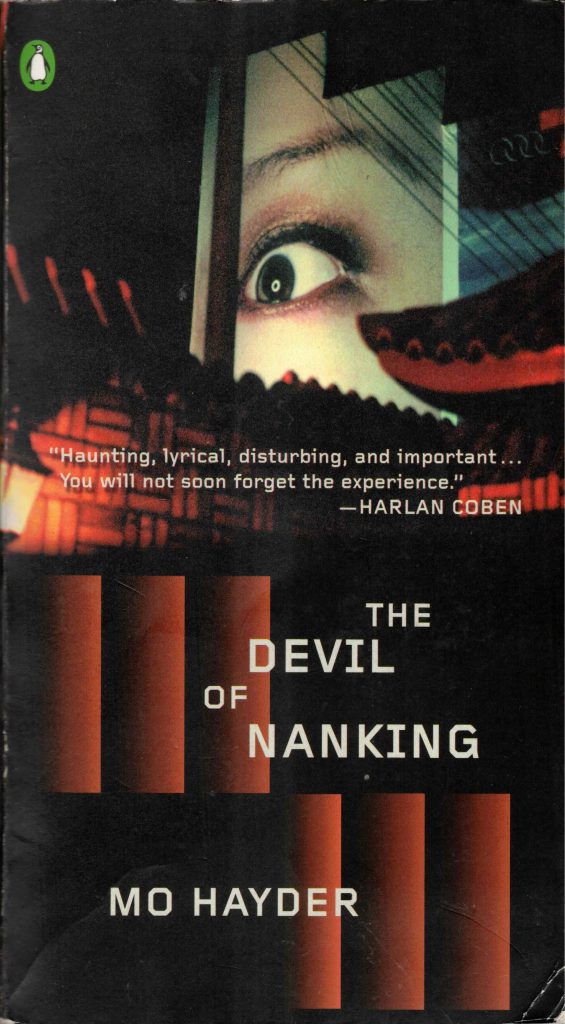
Monday Book Report: The Devil of Nanking

“Some things are too terrible to be true,” sang Bob Dylan on the album he released September 11, 2001. Fiction was invented—in part—to resolve the paradox, to give emotional body to the merely true, to give life where the recitation of facts and history bathes its subject in a deadening radiation of memory and catalogue. Mo Hayder’s The Devil of Nanking cannot have happened, and yet the acrid sting of truth emanates from the complicated story.

Could humans act as the protagonists in Ms. Hayder’s novel act? Evil actors abound in the book, but it is the ignorant innocents who challenge the reader’s suspension of disbelief. Those who face this challenge will find much reward in this difficult thriller. Not all will be able to stomach much of the material, nor should everyone make the attempt; assume any trigger warnings you like, and if you are swayed by such, perhaps best to glance wistfully behind you as you give this book a pass. The ignorant innocents are neither by the time The Devil of Nanking concludes, nor is the book’s reader.

I do not mention the specifics of the plot, as it may be best to come upon this novel unawares, with no preconceptions. There are plot holes and fortuitous circumstance, but the bifurcated story is a unitary whole, with a touching understanding of human psychology beneath some of its seemingly outré details. At the core of the human heart lie some things which cannot be said, because to say them would elide and erase their power, and they are very powerful things indeed. These things are things that ‘everybody’ knows, which makes them all the more shocking when we are forced to face them for the first or second or hundredth time. Such things cannot be seen or spoken of directly, but are always just out of reach. Bound by a strange presque vu geas to never be directly visible, like some optic variant of Tantalus, the deepest truths about we hairless apes must be talked around, hinted at, or shown in action rather than pinned down in an exhibit case. Mo Hayder accomplishes this feat in a rare bit of legerdemain.

Friday Vocabulary

1. flapdoodle — nonsense

Certainly the collapse of that Colorado savings and loan during the ’80s had plenty of suspicious circumstances, but Bill was always peddling some flapdoodle about satanism and child abuse being involved so we just learned to tune him out.


2. lusus naturae — freak, sport of nature, deformed creature

Palmer’s aptitude for whist made him a lusus naturae among the junior officers, and ensured that he spent many hours in the captain’s company.


3. midden — dunghill

All the families of the village are entitled to take from the midden howsoever much they need for fertilizer, providing that they replenish the heap from their own supply of manure.


4. pyrolytic — decomposed (organic material) by subjection to high heat

Medical implants are often made from pyrolytic carbon to reduce the risk of chemical changes during long-term use.


5. redd — to clean or tidy, to put in order, to clear

Well, you’ll never get the house redd up in time if you insist on examining each piece of paper instead of just tossing them into the box to look at later.


6. meiosis — rhetorical figure intentionally portraying something as smaller in size or importance than it actually is

He had a very self-deprecating manner that was at odds with the strange times he lived in, where everyone seemed to promote themselves on so-called social media at every instant of the day, bragging about what they had for breakfast or which shoes they were wearing, while he reported his appointment to the Board of Regents with the meiosis “Got a new job offer today, very excited.”


7. gallimaufry — ragout or hash of odd bits of food; hodgepodge, ridiculous jumble

Her desk was covered with a gallimaufry of items accreted during her tenure: several books on filthy netsuke, sewing patterns from the 1970s, samples of artificial turf, stones which looked like noses, pens almost out of ink, coins, receipts, a half-finished copy of Rabelais, a dried out highlighter, another dried out highlighter, locking pin backs, and a broken abacus.


8. dekko — (British slang) glance, look

She only got a slight dekko at me when the door opened up, and the light was dim; I’m sure she won’t be able to describe me to five-o.


9. larrikin — (Australian) hooligan, (usu. young) street tough

I find it hard to believe he owns the club, since he seems merely a jovial larrikin out on the town.


10. syncope — fainting; sudden stopping, cutting short

Never before had we lived through such a period of governmental syncope, as the flow of money, legislation, and regulation was suddenly cut off, leaving us wondering about its eventual restoration.


Friday Vocabulary

1. titivate (also tittivate) — to spruce or smarten up

We stopped shaving once it became clear that no rescue was forthcoming, save for Harker, who maintained an almost manic hygiene, titivating and preening each morning as if expected a bevy of bachelorettes to stumble into our rude camp of lean-tos and hovels.


2. technolatry — worship of technology

Though it easy to agree with Morozov’s description of Silicon Valley as the Vatican of technolatry, a credulous belief in the power of apps and computers should not be mistaken for worship.


3. termitary (var. of termitarium) — termite’s nest, often mound-shaped

Within the deepest bowels of the termitary the gorged queen lies immobile, eating and birthing to the exclusion of any other activity.


4. teasmade — automatic tea maker, usually with clock so that tea is ready upon awakening, once common in the UK

Awakened by the radio built into the teasmade, Harriet happily pulled herself into a sitting position at the head of the bed and poured out a cup of hot tea, reveling in this pinnacle of civilized life.


5. thence — from that place; from that time; from that cause or source

My brother remains quite comfortable in his club, and sees no reason to sally thence to essay unremarkable perambulations around the so-called social scene with the so-called smart set.


6. tefillin — phylacteries, small black leather boxes worn on the head and arm by Orthodox Jewish men during morning prayer

My grandfather wrapped himself in a prayer shawl and put on the tallis and tefillin every morning without fail, a great mitzvah, he told me.


7. tantalus — small stand or rack containing decanters with a locking bar atop to prevent unauthorized tippling

Lord Hedgeworth took the brandy from the tantalus and poured us both a very large drink.


8. tarn — small mountain lake

Only the tiny tarns were left in these thickly wooded crags to testify to the retreat of the glaciers.


9. tucker — linen, lace, or similar piece worn around top of bodice

The Harvey Girls were renowned for their uniform neat appearance in their best bib and tucker.


10. thrasonical — bragging, boastful

While we believed his story that everybody had been Kung Fu fighting, we thought his claim to have bested the others through his mastery of Dung Beetle style to be merely a thrasonical addition to his tale.


Bonus Vocabulary

(current slang)

caping — defending or supporting an undeserving person

I thought that that scene in church would finally make her wake up, but Ellie is still caping hard for Robbie, no matter what that boy does or says.

400 Books (not really)

Today I finished the 400th book since I began tracking my reading back in 2016. Of course, I generally do not count towards my ‘Books Read’ total those volumes belonging to the Comics & Graphic Novels category, so in my self-approved count, this book is #351. The slim staple-bound almost-a-pamphlet in question is Life on a Coral Reef, by Russ Kinne. It is part of a “Nature Program” series put out in the 1950s by the National Audobon Society, and included in each of the series a set of color stamps with photos accompanying the text, gummed on the back so that the reader could paste them into the book. In this case the stamps had not been pasted in, perhaps because the pictures just weren’t that good. I append below one of the pages of these stamps, so that you can compare with modern underwater photography and see the immense improvements since 1956, when Book #351 (or #400, but we’re not counting that way) was published.

Book List: 4th Century, 2nd Quarter

Continuing my ongoing listing of books most recently read, and continuing the practice just lately begun of presenting such listing in convenient (to me) twenty-five (25) book chunks, for reasons touched upon in the first such set (viewable here), I herewith present the most recent twenty-five (25) books read, #326 – #350 in my count since I began keeping track in 2015. (As usual, I do not include comics and graphic novel books in my count, though they are listed below.)

Book read #326 was and is the first ‘e-book’ I have read, the progenitor of all Scandinavian crime fiction, The Iron Chariot by Stein Riverton. Stein Riverton was the nom de plume of the Norwegian Sven Elvestad, who began his writing career like O. Henry after a small touch of embezzlement. The novel itself is a pleasantly troubling work, not entirely plausible but a nice enough deceitful first-person narration of a puzzling crime. I read this in digital format because I could not find it in physical format, and had read several paeans to this author—for whom the Norwegian crime fiction award is named—so that when I was given a Kindle credit I used it to check out the beginnings of the current Scandinavian mystery boom. The author seems to be ripe for any biographer who understands Norsk, with a strange and secretive life of alcohol abuse and hints of sexual and other mysteries that might repay the researcher who can read the traces left in the palimpsests Elvestad left behind.

Also read at the beginning of this tranche of books was The Case Of The Journeying Boy, a fantastic thriller from Michael Innes. Though passing time has made much of the narration a historical period piece (it was originally published in 1949), Innes wrote a truly brilliant book. Its overdose of erudition frames the story of the protagonist, who is not the titular ‘boy’ but his would-be tutor, troubled by his charge and the bizarre situations the boy manipulates. A few Children’s books show up in this slice, due to new access to some old books of mine, as well as a noted novel I wrote a note on here.

# Read Author Title Genre
326 6/22/19 Stein Riverton The Iron Chariot Mystery
327 7/1/19 Thomas Malory; Sidney Lanier, ed. King Arthur and His Knights of the Round Table Children’s
328 7/2/19 Barbara K. Walker & Maki Tezel The Mouse and the Elephant Children’s
329 7/9/19 Michael Innes The Case of the Journeying Boy Mystery
330 7/15/19 Charlotte Brontë Jane Eyre Fiction


I finally read The Wizard of Oz, which I knew many literary lights and others have cited as their favorite kid’s book. After seeing the interesting display about Oz at the San Diego Country Fair, I jumped once more into the breech and found a very different story than that in the MGM film. The Dorothy of L. Frank Baum is a much more self-confident, much more wholly American, and a much younger (obviously) girl than the heroine portrayed by Judy Garland. Though the Land of Oz gives her many surprises, she meets them all with pluck and intelligence. I look forward to reading more of Baum’s works, to see how well his intention to create truly American fairy tales succeeded. Also of note is John Varley’s The Persistence of Vision, a short story collection made creepy by the passing of time and the Age of Groupies, but of interest nonetheless. The less said about Amanda Cross the better.

# Read Author Title Genre
331 7/22/19 L. Frank Baum The Annotated Wizard of Oz Children’s
332 7/25/19 Amanda Cross Death in a Tenured Position Mystery
333 7/28/19 Amanda Cross In the Last Analysis Mystery
334 7/30/19 Amanda Cross Poetic Justice Mystery
335 7/31/19 John Varley Persistence of Vision SF/Fantasy


The Black Dahlia by James Ellroy is a much tighter and therefore much better book than L.A. Confidential. The gritty (think of the gravel in your scraped knee as a kid) portrayal of the Los Angeles police department during the postwar ’40s makes compelling reading, though the mystery is ultimately less about the Black Dahlia murder and more about Ellroy, as usual. The Herbert Gans text on Popular Culture and High Culture is, of course, a classic sociological text, though the most interesting thing I found in this original edition is the observation that attacks upon ‘low’ culture by the intellectual elite correspond to the erosion of power held by that elite in the society as a whole. The Dragon magazine was read as an exercise in nostalgia, pure and simple.

# Read Author Title Genre
336 8/4/19 Anne Brontë Agnes Grey Fiction
337 8/9/19 Bruce H. Wilkinson The Prayer of Jabez: Breaking Through to the Blessed Life Religion & Spirituality
8/12/19 Doug Miers Trade Paperback #1 Comics & Graphic Novels
338 8/12/19 Kim Mohan, ed. Dragon Magazine No. 102 D&D
339 8/14/19 Herbert J. Gans Popular Culture and High Culture: An Analysis and Evaluation of Taste Sociology
8/15/19 Buddha Comics & Graphic Novels
340 8/20/19 James Ellroy The Black Dahlia Mystery


Finally read Stephen Mitchell’s version of Gilgamesh, a Christmas present from my brother at least a half decade ago. (So don’t be surprised if I don’t immediately read a book you give me or recommend; I’ll get around to it eventually as the planets align.) Mitchell does a good job forming a coherent and compelling narrative out of the often fractured material, but I still feel that I just don’t ‘grok’ the Gilgamesh tale, that it just cannot move me in the same way the tales of crafty Odysseus do. I also read Michael Crichton’s Airframe, a good read recommended by one of the two—or is it three now?—reader’s of this blog’s Friday Vocabulary feature.

# Read Author Title Genre
341 8/24/19 Keith Laumer Zone Yellow SF/Fantasy
342 8/28/19 Stephen Mitchell Gilgamesh: A New English Version Mythology & Folklore
343 8/29/19 Neil Gaiman Smoke and Mirrors SF/Fantasy
344 8/30/19 Frederik Pohl & C.M. Kornbluth Critical Mass SF/Fantasy
345 8/31/19 Michael Crichton Airframe Mystery


Science Fiction also predominates the last portion of these last twenty-five books, and I am likely to focus more on this genre, if only to make some room for books bought but not yet shelved. The absolute highlight of these last five books is the slim Strange Invasions by Michael Kandel, whom you may know as the translator of some of Stanislaw Lem’s books. The novel is a stunner, exploring the boundaries between sane and unsane, both within the mind of the troubled narrator as well as in society as a whole. I already wrote about William Gibson’s Burning Chrome and am happy to report that Neuromancer is a much better book.

Bulmer’s Land Beyond the Map is workmanlike but with interesting ideas, while its tête-bêche partner, Edmund Hamilton’s Fugitive of the Stars is silly but engaging. But Fat Freddy’s Cat beats both storytellers in his recounting of the War of the Cockroaches.


# Read Author Title Genre
346 9/2/19 Michael Kandel Strange Invasion SF/Fantasy
9/2/19 Gilbert Shelton The Adventures of Fat Freddy’s Cat Book 6 Comics & Graphic Novels
9/2/19 Al Moore 1963 – Book Six: Tomorrow Syndicate Comics & Graphic Novels
347 9/6/19 Norman Fischer Sailing Home: Using Homer’s Odyssey to Navigate Life’s Perils and Pitfalls Religion & Spirituality
348 9/8/19 William Gibson Burning Chrome SF/Fantasy
349 9/10/19 Kenneth Bulmer / Edmond Hamilton Land Beyond The Map / Fugitive Of The Stars [Ace Double M-111] SF/Fantasy
350 9/15/19 William Gibson Neuromancer SF/Fantasy


I mentioned the current focus on Science Fiction, and I am also trying to slog through some books I’ve turned up which look like I won’t want to keep them (such as the boring Buddhist book vaguely referencing the Odyssey). The pile next to my bed is a trifle lower, and I have several choices which do not look that good at all in my office. Until next time….

The lists of previously read books may be found by following the links:

Normative Social Theories

“Normative social theories, which are the only relevant answers to problems of value in the social sciences and the humanities, differ radically from this. No normative theory, neither Anglo-American democracy nor Russian communism, neither the Christian ideal nor the Mohammedan ideal for life, could ever hope, nor does it ever pretend, to be completely in accord with what is in fact the case in any specific empirical society. Yet no one takes it as proof of the inadequacy of democracy that there is no actual society anywhere in which the democratic ideal is perfectly realized. One does not take it as an argument against the Christian ideal for life that there are no perfect Christians. Yet, if normative social theories were handled by the same methods as those used for factual social theories, this is precisely what we should conclude when we find our normative social theories to be out of accord with specific facts in any actual society.

“But the whole point of a normative social theory is that it is introduced to change the de facto situation at least in part, rather than to conform to it. It defines the ideal society at which we are aiming. It does not purport to designate, after the manner of a theory in natural science, the de facto state of affairs which we actually have. It is, in short, an answer to a quite different problem and question than the type of problem or question we are trying to answer when we ask for a factual social theory.”

— F.S.C. Northrop

Friday Vocabulary

1. indefeasible — not liable to be annulled or voided, not forfeitable

Any arguments for the indefeasible rights of an author to control his writings are undercut by the works of Franz Kafka, most of which were saved only when his friend Max Brod famously ignored Kafka’s final wishes that his unpublished works be burned after his death.


2. carter — driver of a cart

The shoats quickly fled the overturned wagon, but the dazed carter merely sat mournfully on the kerb, bemoaning his loss rather than seeking to retrieve the runaway pigs.


3. groin — to fashion intersecting vaults or to furnish such vaults with ribs along such an intersection

The builders had replaced the barrel vaults of the original plans, groining the vaults instead for greater strength and stability.


4. apophallation — the biting off of the penis

Two types of slugs have been observed to engage in apophallation during or after mating, though the reasons for this behavior are not entirely clear.


5. enchafe — to make warm or hot

We must beware the effects of excessive drink, for, as Plutarch says, wine has the power to enchafe both the body and the mind.


6. tippet — narrow scarf worn with ends hanging down over shoulders; band of silk worn by clergy around neck with ends pendent from shoulders; woman’s shawl or scarf worn around neck and shoulders

In the 19th Century the proctors at the University of Cambridge wore the tippet in place of the hood worn by other officials.


7. clinker — fused matter left behind from burning combustible material in furnace or forge, piece of slag

Natural cement is composed from the finely ground clinker formed after burning the appropriate limestone.


8. eupeptic — having good digestion; of or related to a good digestion

I envied him his youthful strength, his happy mien, his eupeptic state that seemed so to contrast with my own crabbed, pain-wracked, and sour disposition.


9. mantic — of or related to divination

The priestess lay dazed upon the bed of animal hides, her mantic frenzy now evaporated leaving only the memory of her words of doom.


10. cumbrous — unwieldy, cumbersome

For ages readers have bemoaned the cumbrous volumes they were forced to read from, but only our day has seen these troublesome tomes replaced with virtual books that can be carried in the pocket.